Showing posts with label Mark 11. Show all posts

Thursday, May 15, 2014

Mark 11:27-33-- Truth for Evil's Sake

They came again to Jerusalem. And as He was walking in the temple, the chief priests and the scribes and the elders came to Him, and began saying to Him, "By what authority are You doing these things, or who gave You this authority to do these things?" And Jesus said to them, "I will ask you one question, and you answer Me, and then I will tell you by what authority I do these things. Was the baptism of John from heaven, or from men? Answer Me." They began reasoning among themselves, saying, "If we say, 'From heaven,' He will say, 'Then why did you not believe him?' But shall we say, 'From men '?"— they were afraid of the people, for everyone considered John to have been a real prophet. Answering Jesus, they said, "We do not know." And Jesus said to them, "Nor will I tell you by what authority I do these things."

Jesus had made quite an impact in Jerusalem in the two days he was there.  The first day he was proclaimed as the king of Jerusalem by many people.  The second day he threw tables and money around the temple, proclaiming it to be unclean.  The leaders in Jerusalem are stunned and offended by these actions.  The first implied that their leadership would be replaced.  The second clearly proclaimed that their handing of the temple was evil before God.  And Jesus’ act in the temple might also imply that he was predicting the destruction of the temple.  So the leaders of Jerusalem wanted to know why he thought he could do these things.

The three groups that were confronting Jesus here were the scribes, who were Bible experts, the elders, who were members of the ruling body called the Sanhedrin and the ruling priests.  These were leaders of all Judaism, throughout the world.  And these were the people Jesus was confronting from the time he proclaimed God’s kingdom to be coming.  They are fundamentally content with the status quo and wants to keep things as they are—Jesus, on the other hand, is proclaiming radical changes.  So they want to know why Jesus had the right to do what he was doing—who gave him the authority.

Of course, the simple answer would be that Jesus received this authority from God—Jesus and John heard the voice from heaven.  But instead of giving them the simple answer, Jesus said he wanted to know what they thought of John’s proclamation—was it from God or not?  This question was essential to Jesus’ answer.  If they thought that John was sent from God, then they could accept Jesus—but if they did not, they would not accept him.  Mark then allows us to hear their discussion with each other—they didn’t really believe in John’s proclamation, but they didn’t want to say so publicly.  And if they said John was sent from God, then Jesus would rebuke them.

So they took the safe course—they said they didn’t know.  Jesus replied that since they refused to commit themselves one way or another about John, then he wouldn’t answer their question.  If he answered them, it would open himself up to a public rejection.

Most of the time, when we ask a question, we want to have an answer.  But the gospels are full of people who ask questions in order to avoid other questions, to trap someone, to avoid responsibility.  

Curiosity is good and it is a human trait God created in us.  But we can use the veneer of what is naturally human to be cruel, to be underhanded and to be passive-aggressive.  If we use a question in this way, we can always say, "It was just a question... sheesh... why make such a big deal about it?"  

Other times, people will ask a question that shouldn't be answered, even if it is sincere.  If the Nazis come to your door and ask if Jews are there, that's not a question that should be answered.  Hate uses truth for evil purposes. 

It is a sad thing when we use what is good for the purpose of evil.  What a sad world we live in that it happens all the time.

Mark 11:19-26-- Conditional Love

When evening came, they would go out of the city. As they were passing by in the morning, they saw the fig tree withered from the roots up. Being reminded, Peter said to Him, "Rabbi, look, the fig tree which You cursed has withered." And Jesus answered saying to them, "Have faith in God. Truly I say to you, whoever says to this mountain, 'Be taken up and cast into the sea,' and does not doubt in his heart, but believes that what he says is going to happen, it will be granted him. Therefore I say to you, all things for which you pray and ask, believe that you have received them, and they will be granted you. Whenever you stand praying, forgive, if you have anything against anyone, so that your Father who is in heaven will also forgive you your transgressions."

After Jesus’ prophetic act in the Temple, the disciples passed by the fig tree again and they noticed that it was withered completely.  Peter spoke to Jesus in surprise that Jesus’ curse was so quickly achieved, and so thoroughly.  

But when Jesus cursed the fig tree, he wasn’t just speaking of the tree itself, but of the leaders of Judea—the priests and scribes and Sanhedrin.  They have defiled the Temple of God with their policies, and not allowed God’s people to worship him—thus they had no fruit of devotion to God or love of one’s neighbors (this is the point of Luke 13:6-9, which is probably based on this incident).  

Jesus answered Peter’s statement, not as if he were speaking about the fig tree, but about the temple.  Jesus spoke about prayer in general, and the central place of prayer—where prayers are heard and answered—is the Temple (See II Chronicles 7:15-16).  However, Jesus is declaring that any place is good for prayer, if one has faith.  The “mountain into the sea” saying was a common saying among Jewish people, speaking of anything impossible.  Thus, Jesus declares that anything impossible can be heard and answered by God, if the one requesting it has faith—with or without the Temple.  

Jesus also places one more requirement on prayer—that to be accepted by God, we also have to accept those who have sinned against us.  If we do not forgive those who sin against us, God will not forgive us. Thus, Jesus' requirement for prayers to be heard is faith and forgiveness, not proximity to the Temple.

God loves everyone, but not equally.  God, Jesus says, gives food to all and rain to all and opportunity to His grace to all.  But God doesn't answer everyone's prayer, or give everyone ultimate salvation.  Everyone has the opportunity for it all, but Jesus said that the wealthy and the condemning will have a harder time of it.

Certain kinds of God's love have conditions.  Not everyone is going to have every prayer answered, just because they pray.  They need to have faith, or trust in God's requirements for answering our prayer.  God won't just make us rich, as much as we might believe, because we won't show true faith by conforming to God's compassion and sacrifice.  God won't heal our heart because we refuse to forgive those who hurt us.  

Often we have to take the baby steps before God will give us the opportunity to run.


Mark 11:15-18-- Turning It Right-Side-Up

Then they came to Jerusalem. And He entered the temple and began to drive out those who were buying and selling in the temple, and overturned the tables of the money changers and the seats of those who were selling doves; and He would not permit anyone to carry merchandise through the temple. And He began to teach and say to them, "Is it not written, ‘My house will be called a house of prayer for all nations'? But you have made it a rebels’ cave." The chief priests and the scribes heard this, and began seeking how to destroy Him; for they were afraid of Him, for the whole crowd was astonished at His teaching.

After investigating the Temple area the day before, Jesus takes action.  Immediately upon entering the Temple area, he begins to throw out anyone buying, selling or exchanging money in the temple area—he even cast out those who were carrying possessions around.

The problem with the practices Jesus was stopping was twofold:
a.  The temple is a place of holiness, and nothing unholy should enter into the temple place.  In the ten commandments, one thing that is exceedingly unholy is an image of anything on earth, especially in order to worship it (Exodus 20:4-5).  The Jewish people were extremely sensitive to this, and held a non-violent riot a number of years before Jesus’ entrance into Jerusalem to declare that Roman standards with images would not be allowed in Jerusalem.  Yet there were images of people on the coins they brought into the Temple area—and this is an abomination.   It makes the Temple a place of rebel bandits (not thieves), for they are serving images, not God (which is the point of the passage Jesus’ quotes, Jeremiah 7:9-11).

b. The Temple has a number of different sections—the Holy of Holies where the high priest alone went into God’s presence; the Holy place which is open to every male Israelite who worships Yahweh; and the outer court, called the court of Women and Gentiles.  It is this outer court that the sacrifices were held, and it was the only place where women and those not born Israelites could worship God.  And it is in this outer court where the buying and selling was taking place, which was preventing the women and gentiles to worship.  Jesus declares the purpose of the temple in the words of Isaiah 56:7—The temple is a place to be able to focus prayer on God.  And it is to be open to all the nations.  But the practice of  buying and selling in the outer court does not allow the nations to pray.

The priests were very upset with Jesus, because it was a declaration of the High Priest and the ruling elders that allowed the buying and selling to go on in the outer court.  They would arrest him for ceasing what the law allowed.  They could also be angry because his violent action might imply that the temple would be destroyed—perhaps by Jesus himself.  But they couldn’t argue with his use of Scripture, and so they let him be.

One other aspect is that such policies are determined by the high priest.  Jesus isn't going through the usual channels of changing things in the temple by going through the priestly system, or even by speaking to the high priest.  Rather, he is just changing the make up of the temple, setting things right, as if he were the high priest himself.

Jesus had gone to the Temple many times in his life.  As an observant Jew, he needed to go to the Temple at least once a year, perhaps three or four.  Jesus had seen the wrongs at the temple many times before.  He knew that women and Gentiles were being kept away from the Emperor of the Universe, away from His love and grace.  But he didn't do anything about it, until this time.

Why did he wait?  Because he knew it was one of the last things he would do.  In order to accomplish this work, he had a lot of groundwork to lay first.  He needed to give his disciples an interpretation of the law.  He needed the kingdom of God to be based on healing and resurrection.  He needed to establish, in secret, his real identity.  And then he could do this radical work, which would eventually end his life.

Let no one tell you that Jesus' path is the quiet path.  That it is the path of only gentleness, only humility.  There is a time to toss the tables, a time to make a scene, a time to call out those who keep people from God.   But let no one tell you that the time for radical action is any time or every time.  It must be done carefully, with God's direction and with much wisdom. 

May God give us this wisdom and this boldness.

Sunday, May 11, 2014

Mark 11:11-14-- Poor Fig Tree!

Jesus entered Jerusalem and came into the temple; and after looking around at everything, He left for Bethany with the twelve, since it was already late. On the next day, when they had left Bethany, He became hungry. Seeing at a distance a fig tree in leaf, He went to see if perhaps He would find anything on it; and when He came to it, He found nothing but leaves, for it was not the season for figs. He said to it, "May no one ever eat fruit from you again!" And His disciples were listening.

In this section in Mark, from 11:11 to 11:26, action goes back and forth from the Temple to a fig tree that Jesus curses.  The two stories are connected in Mark, the fig tree being an illustration of the leadership in Jerusalem who is in charge of the Temple.  In this first section, Jesus comes into Jerusalem after the procession declaring him king, and he investigates the temple, as if he is looking for something.  Jesus was not actually staying in Jerusalem, but in Bethany, a town just outside of Jerusalem.  After he had spent the night out, he and his disciples were returning to Jerusalem and Jesus spies a fig tree.  After seeing it had no fruit, Jesus curses it.  But the surface reason—that it had no fruit—seems unreasonable for a curse.  Yes, he was hungry, but it was not the season for figs.  Is he just cursing out of anger?  It seems unreasonable, but perhaps we shall see another reason for his cursing.

There are a number of times when Jesus just seems grumpy.  I mean, really, why curse a poor fig tree without fruit?  Don't you think the tree's got enough problems?

But Jesus didn't harm in anger.  He was looking for a teachable moment, and he was making sure that his disciples were paying attention.  Not because he wanted them to learn the right words to curse with.  But because they needed to learn.

There is a time to feign anger in order to teach.  All things, even anger, must be used for the benefit of others.

Mark 11:1-10-- Show, Don't Tell

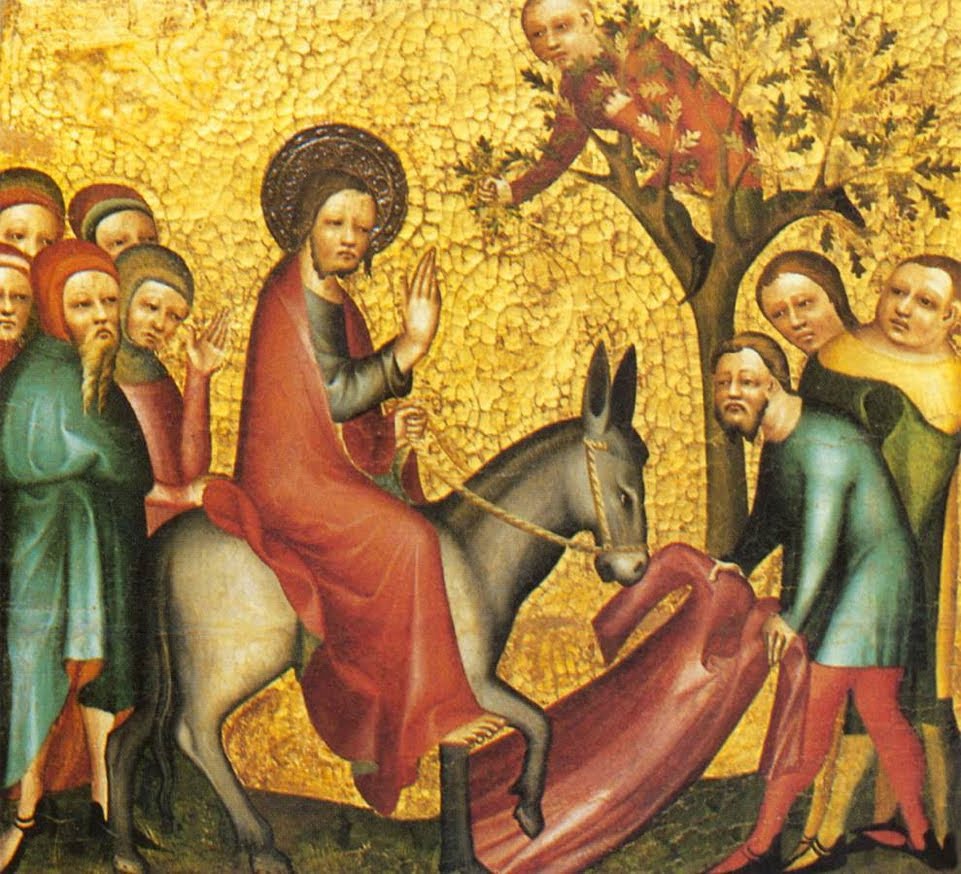
As they approached Jerusalem, at Bethphage and Bethany, near the Mount of Olives, He sent two of His disciples, and said to them, "Go into the village opposite you, and immediately as you enter it, you will find a colt tied there, on which no one yet has ever sat; untie it and bring it here. If anyone says to you, 'Why are you doing this?' you say, 'The Lord has need of it'; and immediately he will send it back here." They went away and found a colt tied at the door, outside in the street; and they untied it. Some of the bystanders were saying to them, "What are you doing, untying the colt?" They spoke to them just as Jesus had told them, and they gave them permission. They brought the colt to Jesus and put their coats on it; and He sat on it. And many spread their coats in the road, and others spread leafy branches which they had cut from the fields. Those who went in front and those who followed were shouting: "Hosanna! Blessed is he who comes in the name of the Lord; Blessed is the coming kingdom of our father David; Hosanna in the highest!”  

Now Jesus is entering Jerusalem.  In the book of Mark, this is the beginning of the end.  The prophecies Jesus declared are now being set up, and the tension increases until Jesus’ death.  

Jesus prepares for his entrance by telling his disciples to get a colt.  While the kind of colt isn’t described in this version of the story, but since donkeys were much more available to Judeans than horses, we can assume (as other versions say outright—Matthew 21:2) that it is a donkey.  How the colt was gained, we aren’t sure.  Did Jesus know the man from whom the disciples borrow the colt, and it was agreed that Jesus would borrow it when the time was right?  Was it a miracle?  Did the man allow anyone who declared God’s name to borrow his things and Jesus knew about this?  We don’t know.  All we know is the disciple’s perspective—Jesus gave them vague instructions and they easily borrowed the colt.  

The way of borrowing it, though, is not as important as the reason for borrowing it.  Jesus was interested in making his entrance into Jerusalem an event that would be noticed.  In riding a colt, he is purposely fulfilling Zechariah 9:9, which say that Jerusalem’s king would enter the city on a donkey colt.  Jesus’ disciples picked up on the meaning, and they piled their outer garments on the colt, so Jesus could show his mastery over them by sitting on their coats.  

As Jesus entered Jerusalem, others saw him.  They were clearly people who knew him, but they may not have been people who followed him.  But these others—possibly residents of Jerusalem—spread their coats on the road before him, declaring his mastery over them. (Other gospels say that it is his disciples honoring him at this time.)  Others spread branches before him, as one would do when a victorious captain or ruler of a city is returning to his city.  Still others were quoting Psalm 118:26, which was understood to be a passage about the coming Messiah.  These who were quoting Psalm 118, also called David “our father”.  But David was not the father of all Israel, nor even all Judea.  He is the father of those who considered themselves to be in the ruling line—those who could possibly be declared king.  And they are showing their submission to Jesus.  The whole scene is showing one thing—Jesus is the Messiah, the true ruler of Jerusalem.  Clearly, those who ruled Jerusalem at this time would not take kindly to this event, as it would indicate that the people would like them deposed and Jesus put in their place.


The tight-lipped Jesus
There are many scholars who say that, in a historic analysis, Jesus never clearly called himself messiah. That may be true in his words.  But we have this one action, which is attested to by all four gospels, in which Jesus clearly declared himself the king of Jerusalem, and almost all the residents of Jerusalem understood this.

Jesus' followers, mostly from Galilee, might not have known the prophecy of Zechariah that the king of Jerusalem would come in on a young colt.  Why is this such a big deal?  Because no self-respecting victory parade would have the focus of the parade be put on a colt, especially one on which no one had ridden.  Such an animal would be short, and he might buck or refuse to move. Someone looking to be exalted and honored would ride an experienced horse.  So it would be a rare thing for the head of any parade to ride a colt. Unless that person was fulfilling a specific prophecy.


Jesus fulfilled his own prophecies, as often as he could.  He purposed to be seen as messiah and king, but rather than just saying it outright, he wanted to let the Scriptures do the talking.  Often we don't need to say things directly.  All we have to do is show through our actions what God wants us to do.  The most important people will get the message.