Showing posts with label Mark 10. Show all posts

Sunday, May 11, 2014

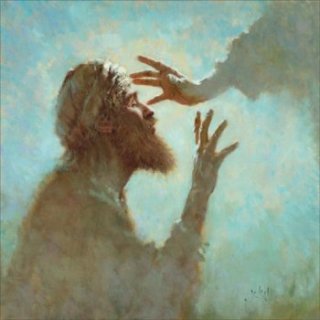
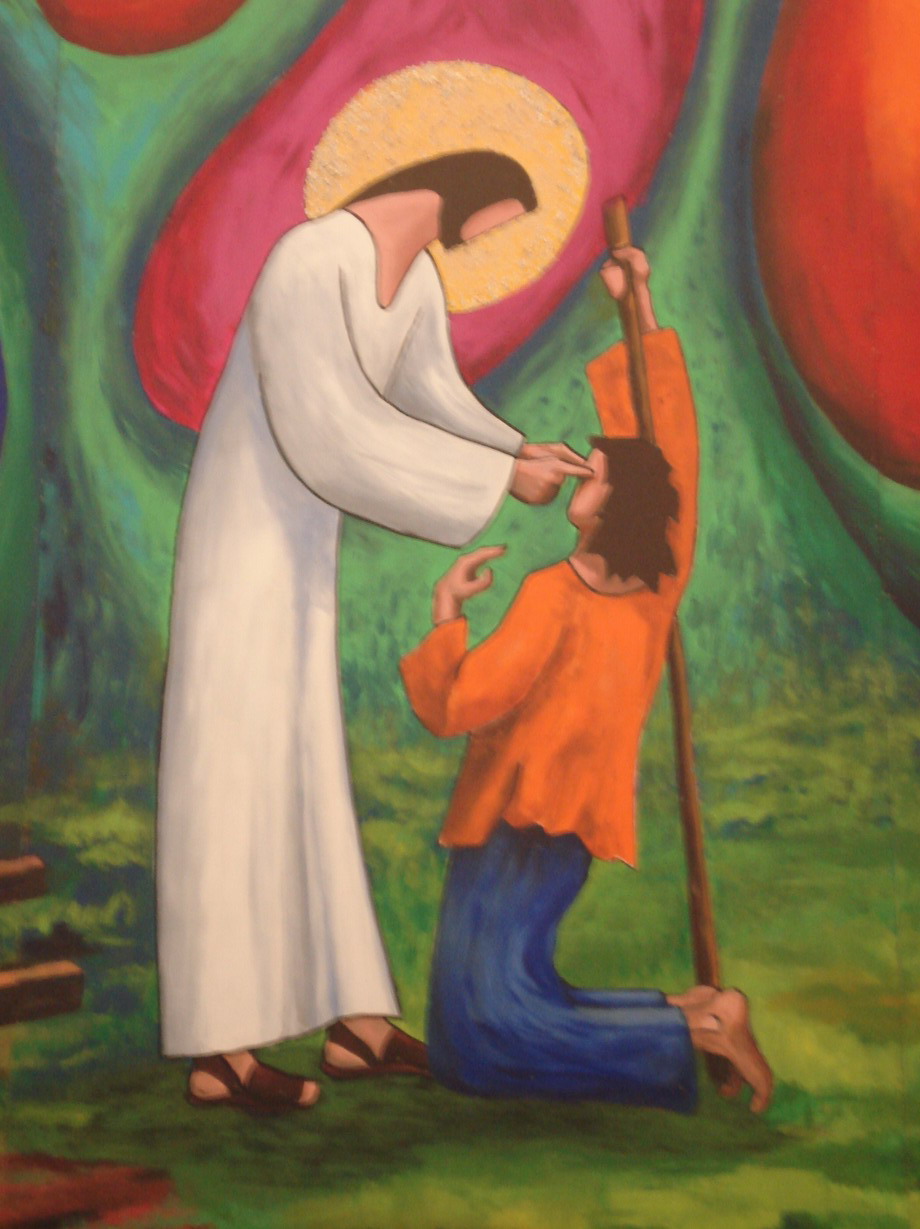
Mark 10:46-52-- Faith is a Highway

Then they came to Jericho. And as He was leaving Jericho with His disciples and a large crowd, a blind beggar named Bartimaeus, the son of Timaeus, was sitting by the road. When he heard that it was Jesus the Nazarene, he began to cry out and say, "Jesus, Son of David, have mercy on me!" Many were sternly telling him to be quiet, but he kept crying out all the more, "Son of David, have mercy on me!" And Jesus stopped and said, "Call him here." So they called the blind man, saying to him, "Take courage, stand up! He is calling for you." Throwing aside his cloak, he jumped up and came to Jesus. And answering him, Jesus said, "What do you want me to do for you?" And the blind man said to Him, "Rabboni, I want to regain my sight!" And Jesus said to him, "Go; your faith has made you well." Immediately he regained his sight and began following Him on the road.

Jesus now enters into Jericho. This is in the land of Judea, and Jesus is getting close to Jerusalem, although he is not going a direct route, but he went first to the east of Jerusalem.  
Bartimaeus’ full name is given, so he is probably known to disciples after the death of Jesus.  The blind man calls out to Jesus as the “Son of David”, or the Messiah—this title is used again later (Mark 12:35).  So he understands Jesus to be the Messiah and is pleading for mercy from this king. 

He was yelling loudly and incessantly—frankly, he was making a scene.  People told him to be quiet, to not make a scene, but since he was not getting the Messiah’s attention, he kept on, ignoring those trying to quiet him. Rather than assuming what he wanted, Jesus asked him.  The blind man wanted to be healed, and Jesus obliged him.  The term “Rabboni” is Aramaic for “rabbi”, which means “master” or “lord” and is often used for teachers.  

Jesus declares that his faith has made him well.  Bartimaeus showed faith in a number of ways: a. He called Jesus the Messiah, b. he persisted in crying out for salvation, even when others told him to be quiet and c. he insisted that Jesus had authority over his blindness.  After his healing, he remained with Jesus, following him as a disciple—which no other one healed does in Mark (although the demoniac in Mark 6 asks to). 

Different people reacted different way in relation to Jesus, even when the reaction was positive.  Niccodemus believed that there was something special about Jesus, but he couldn't put his finger on it.  Others, like the woman at the well, boldly proclaimed who Jesus was.  Some were healed by Jesus, but didn't really want to have anything to do with him (nine lepers).  Others followed Jesus without really understanding him.  Then there is the rare person like Bartimeus who immediately followed Jesus after his healing.

Jesus talked to them all, encouraged them all to go deeper in their faith.  Jesus understood that faith wasn't a one time act, but a process that many would take their whole lives to work out.  He was patient with them all, and didn't expect more out of them then they could give.  He rebuked when necessary, sometimes gently, sometimes firmly.  But Jesus never gave up on any, except those who rejected him without trying to understand.  

Often we reject people because they aren't on our level of faith.  We think they are incomplete in their faith, and they couldn't possibly be pleasing to God.  Well, they don't have their whole faith.  Neither do we.  If we looked at our younger self in faith, we might condemn that person as well.  But God didn't and doesn't.  He knows that faith is a path, and we are all in the middle of walking on it. 

Mark 10:41-45-- Slaves of Love

Hearing this, the ten began to feel indignant with James and John. Calling them to himself, Jesus said to them, "You know that those who are recognized as rulers of the Gentiles lord it over them; and their great men exercise authority over them. But it is not this way among you, but whoever wishes to become great among you shall be your servant; and whoever wishes to be first among you shall be slave of all. For even the Son of Man did not come to be served, but to serve, and to give His life a ransom for many."

The other disciples were upset that James and John had the guts to ask for the top leadership positions in the coming kingdom.  Some were upset at their forwardness, but surely others were upset because they didn’t think of it first.  

Jesus, hearing this upset at James and John, determined that it was time to hold a seminar on leadership.  Jesus first describes the way that Gentiles lead.  Gentiles, Jesus said, rule with their own benefit in mind.  They control others for their own honor, so that everyone will know that they are great.  

Leadership in God’s kingdom, however, will be the opposite of this. The great will be a “server”.  The most important among the leadership will be a “slave”.  This seems to work on a number of levels.  First of all the terms used—“server” (deacon in Greek) and “slave” are used in the New Testament as titles.  “Deacons” are those who help the poor and do administrative work in a congregation (Romans 16:1; Acts 6:2-3; I Timothy 3:8).  The most important leaders of the church are called “slaves of Christ” (Romans 1:1; II Peter 1:1).   These titles of “slave” and “servant” keep one humble in the midst of lofty titles, such as “Most Reverend” or “Excellent”, as the Latin tradition is.  But these titles also indicate something about the kind of work they do.  They are not to act for their own benefit, but they are to act for the benefit of others—serving, leading for the sake of other’s needs.  

And also, these are not to be lofty positions, but those in these positions should remain humble.  This does not mean just a lack of pride, but taking on tasks and suffering rebuke and persecution that would befit only the lowest of society.  As the best example of this, Jesus presents himself.  He spoke of his own persecution and death three times now.  He was heading to Jerusalem, not to take on a position of glory, but to experience the most humbling death on earth—crucifixion.  And he was not going to Jerusalem so that he would be benefited.  Rather, he was going for the benefit of many.  Specifically, he was allowing himself to be a ransom—a price paid to free someone from slavery.  Jesus knew that his death would open up the way to begin God’s kingdom, which would offer everyone a way to be reconciled with God and to fulfill God’s promises on earth.  Jesus was ready to suffer humiliation for the sake of all.  And this is the kind of leadership he was expecting from the disciples.

Leadership in the church is a tempting proposition.  It isn't like the first century, when leadership in the church was very likely to be a death sentence.  We look at popular church leaders and see their fame, their charisma, their educated air, the respect they obtain, the influence they wield and (sometimes) their professional status and salary.  They obtain everything good the world has to offer.

Yet it seems that Jesus has no respect for these kinds of leaders at all.  The respected, comfortable leader isn't really the Jesus-leader that Jesus wants from his followers.  The real leader is the slave of love.  They are the ones who will surrender their salary so another can eat.  They are the ones who will stand with the hated of society, and so be tarred with their brush.  They are the ones who are always looking for the benefit of others and so often their needs remain unmet.  They refuse the lofty titles of "Father" or "Reverend", never taking away the glory of God. 


The most honored leaders in Jesus' kingdom does dishes and cleans up vomit.  They wash clothes and move the possessions of the needy.  And if someone else needs glory more than they, they will let them have it.  The only glory they need is the appreciation of God.  These leaders are few and far between, but if you look for them you can find them.  There may be good speakers and good teachers, but these are the leaders we should follow.

"The slave of love goes to bed each night as if he had been beaten." 

Mark 10:35-40-- Will You Drink the Cup?

James and John, the two sons of Zebedee, came up to Jesus, saying, "Teacher, we want You to do for us whatever we ask of You." And He said to them, "What do you want me to do for you?" They said to Him, "Grant that we may sit, one on your right and one on your left, in your glory." But Jesus said to them, "You do not know what you are asking. Are you able to drink the cup that I drink, or to be baptized with the baptism with which I am baptized?" They said to Him, "We are able." And Jesus said to them, "The cup that I drink you shall drink; and you shall be baptized with the baptism with which I am baptized. But to sit on my right or on my left, this is not mine to give; but it is for those for whom it has been prepared."

As stated in the last post, Jesus’ method of gaining leadership of the kingdom of God was for himself to be rejected, tortured and killed by the current leadership.  The disciples, however, believed in gaining leadership the old-fashioned way—by connecting with powerful people.  Jesus was powerful, and was going to be the King of Israel, they firmly believed.  So James and John decided to move ahead of the pack and just ask Jesus about gaining the top positions in the new kingdom, right next to Jesus.  

Jesus responded to their request by mentioning that they had no idea what they were asking.  Jesus speaks of the suffering he has to go through, and asks if they were willing to do the same.  When Jesus speaks of “the cup”  it is almost always in the context of suffering and martyrdom (Mark 14:23-24; 14:36; John 18:11).  Baptism is associated with a dangerous passage across water, including death (Luke 12:50; Romans 6:4;I Corinthians 10:1-2; Colossians 2:12;  I Peter 3:21)—although the disciples could have misunderstood and thought he was speaking of simple cleansing by water (Luke 11:39 uses the word “baptize” to indicate washing).  

Clearly, the disciples thought that the requirements he was asking them to do was a simple matter.  He indicated that they would suffer as he.  But then he disappointed them.  For the Father is the one who knows who will be in the topmost leadership positions in the kingdom, and the Son has no authority to offer them to anyone.

At some point in our experience of following Jesus, he will ask us, "Are you willing to drink the cup I drank?"  Of course, if we are confronted by him like James and John were, we would say, "Yes, of course, Lord.  We'll follow you anywhere.  Just ask. Whatever you want."  But Jesus just sits back and waits.  Waits to see not what we say, but what we do.

James and John, of course, ran at first sight of Jesus being arrested.  This is because they thought that suffering would come in the context of fighting, in defending Jesus.  But Jesus didn't want defense.  He didn't want others to suffer at the hands of his disciples.  It was his purpose to suffer and his disciples to suffer with him.

What will we do, when the moment of trial comes?  Will we accept the suffering of Jesus, or will we pass on the cup?  Will we accept difficulty and risk and suffering for the sake of Jesus and love, or will we back off?  Most likely we will hesitate and scatter at first.  But, like John who turned back to sit at the foot of the cross and like James who was the first of the twelve to die a martyr's death, we will have a chance to re-consider Jesus' question. 

Tuesday, May 6, 2014

Mark 10:32-34-- After the Storm


They were on the road going up to Jerusalem, and Jesus was walking on ahead of them; and they were amazed, and those who followed were fearful. And again He took the twelve aside and began to tell them what was going to happen to Him, saying, "Behold, we are going up to Jerusalem, and the Son of Man will be delivered to the chief priests and the scribes; and they will condemn Him to death and will hand Him over to the Gentiles. They will mock Him and spit on Him, and scourge Him and kill Him, and three days later He will rise again."

Jesus was heading toward Jerusalem, and that disturbed the disciples greatly.  The leaders that came from Jerusalem already rejected Jesus, even calling him a representative of Satan (Mark 3:22)!  So they knew that there would be some kind of confrontation in Jerusalem, which they didn’t want to face.  Jesus, however, was confident, knowing that he would be rejected, condemned and then sentenced to be killed.  He knew that the leaders in Jerusalem would do any manner of persecution to him—including mocking, spitting, lashing and killing.  But he was also confident in God’s vindication of him as he is resurrected.  The disciples, of course, was confident in no such thing.  

It is always good to rely on God's promises.  God promises us that we will suffer.  That's a promise.  I've often wondered why people worry so much about the good suffering-- Jesus said it would happen, so why fret?  Just enjoy the ride.  And remember, God is always there to vindicate you when it is all done.  After the storm comes the peace, never before.

Mark 10:28-31-- The Biggest Gamble

Peter began to say to Him, "Behold, we have left everything and followed you." Jesus said, "Truly I say to you, there is no one who has left house or brothers or sisters or mother or father or children or farms, for My sake and for the gospel's sake, but that he will receive a hundred times as much now in the present age, houses and brothers and sisters and mothers and children and farms, along with persecutions; and in the age to come, eternal life. But many who are first will be last, and the last, first."

All the disciples are uncomfortable with the conversation they have been having with Jesus.  They found out that it is difficult—almost impossible for rich people—to be saved.  And that everyone must sell their possessions and give to the poor.  Peter then personalizes the issue Jesus brought up—“Well, Lord, we haven’t sold everything we had.  So we haven’t obeyed you in this way.  But we want to be saved.  And we have left everything we had in order to follow you—is that enough?”  

Jesus replies in the affirmative and speaks of what those have given up will gain.  Those who have given up things for the sake of Jesus includes those who have left their living spaces for Jesus, those who have left their family for him, and those who have quit their jobs or their inherited land.  

They who give up these things for Jesus, or for the message of Jesus—specifically the message that the kingdom is coming and everyone needs to prepare for the next age—will gain the following things:  First of all, they will gain more houses.  In Mark 6:10-11, the disciples of Jesus who are proclaiming Jesus’ message will find other houses to live in.  Secondly, they will gain additional family—many, many more family members.  In Mark 3:33-35 this family are those who are disciples of Jesus, who are obeying God’s word.  

Also, Jesus says, they will gain persecutions.  In Mark 13:9-13  Jesus says that those who are disciples of Jesus will gain terrible trials and suffering before the end.  But, Jesus says, in the end, they will gain eternal life.  Jesus is presenting a very different idea of gaining God’s blessing—he is saying that one must surrender everything he or she has—his whole life—and then receive only what God provides, including persecution from those who do not understand God’s ways.  Only when one gives up on this age will the next age be open to them.  This goes hand-in-hand with Jesus’ teaching on the cross (Mark 8:34-38), and his own passion that he prophesied is soon coming (Mark 8:31).

In following Jesus, our whole value system turns upside down:
We surrender what is most important to us to gain the unseen.
We obtain resources we would have never thought possible.
We rejoice in the suffering that makes our lives difficult.

But if we do not surrender, we cannot enter.
If we don't share, we gain nothing from others.
If we avoid suffering, we never gain the benefits.

Following Jesus is taking the biggest gamble, for the greatest reward.

"Dear God, I am so afraid to open my clenched fists!
Who will I be when I have nothing left to hold on to?
Who will I be when I stand before you with empty hands?
Please help me to gradually open my hands
and to discover that I am not what I own,
but what you want to give me.
And what you want to give me is love,unconditional, everlasting love."
-Henri Nouwen

Mark 10:23-27-- How Hard Is It?

And Jesus, looking around, said to His disciples, "How hard it will be for those who are wealthy to enter the kingdom of God!" The disciples were amazed at His words. But Jesus answered again and said to them, "Children, how hard it is to enter the kingdom of God! It is easier for a camel to go through the eye of a needle than for a rich man to enter the kingdom of God." They were even more astonished and said to Him, "Then who can be saved?" Looking at them, Jesus said, "With people it is impossible, but not with God; for all things are possible with God."

The man Jesus was just speaking with left sadly because of the difficulty to follow the command, “Sell your possessions and give to the poor.”  This command is given to all the disciples in Luke 12:33, and is also stated more obscurely in Matthew 6:19: “Store up your treasures in heaven.”  Now Jesus tells the disciples privately an even more difficult saying—That most wealthy people find it impossible to enter God’s kingdom.  The disciples were so amazed that they didn’t believe that Jesus could be saying it.  They were of the opinion, like most (even Tevya in “Fiddler on the Roof”) that it is easier for a wealthy person to be pleasing to God.  They have the luxury to pray whenever they want, and also they seem to have God’s blessing already on them.  

Jesus repeats his statement even more strongly, and broadens it—that it is difficult for anyone to be pleasing to God, but it is near impossible for a wealthy person to be saved.  The camel through the eye of the needle saying  is a proverb for something that is impossible, as Jesus states both before and after the saying.  

The disciples were stunned and then wondered aloud how is it possible for anyone to enter the kingdom of God.  After all, if it is impossible for those whom it is easier, then no one can be saved.  They haven’t yet understood that Jesus was saying that a wealthy person has a harder time being pleasing to God.  Jesus allows them their concept, though, that almost no one can be saved.  He comforts them, then by stating that with God’s help, anyone can enter God’s kingdom.  This does not set aside the commands Jesus stated above.  Rather, he was saying that no one can obey God’s commands without God’s help—including selling one’s possessions and giving to the poor.  Thus, to gain salvation, one must ask God’s assistance to obey God’s commands.

If we look at the perfection of God, none of us can compare.  We all fail.
If we look at the grace of God, we are all welcome. Everyone is able to enter God's presence.
But one thing God never compromises: His love found in the hearts of men.  If we don't have enough love to surrender our possessions for the sake of one who needs it, then we do not love enough for the presence of God.
If we don't have enough love to forgive those who wronged us, we don't have enough love for the presence of God.
If we don't have enough love to be gentle and kind with those who are below us, we don't have enough love for the presence of God.
This seems like a pretty high standard.  But if we ask the Lord, he is able to pull us to that standard.  He may not be able to make us pure or holy enough for the church, but He can make us loving enough to rest in Him.

Monday, April 14, 2014

Mark 10:17-22-- Stuff

As He was setting out on a journey, a man ran up to him and knelt before him, and asked him, "Good Teacher, what shall I do to inherit eternal life?" And Jesus said to him, "Why do you call me good? No one is good except God alone. You know the commandments, ‘Do not murder, do not commit adultery, do not steal, do not bear false witness, do not defraud, honor your father and mother.'" And he said to him, "Teacher, I have kept all these things from my youth up." Looking at him, Jesus felt a love for him and said to him, "One thing you lack: go and sell all you possess and give to the poor, and you will have treasure in heaven; and come, follow Me." But at these words he was saddened, and he went away grieving, for he was one who owned much property.

An anonymous man shows great respect to Jesus by kneeling before him and calling him “Good teacher.”  He is clearly one who is sincere in wanting to honor Jesus and respectfully listen to his teaching.  Jesus responds to the man without much respect—disagreeing with him being called “Good” saying that such a title belongs only to God. Perhaps Jesus thought that the man was trying to "butter him up" to give him a fair answer to his question.
But the question the man asks is sincere, and comes to the point—although it was much disagreed with by many scholars of his day—“how does one gain eternal life?”  As seen in the following discussion, this matter, “eternal life” could also be called “having treasure in heaven,” or “entering the kingdom of God” or “being saved.”  They are all talking about the same thing: gaining the promises and blessings of God after this age or life is over.  

And this man sincerely wanted to know how to gain it.  Jesus response is the obvious one, one that all teachers would approve of, and that the man would have heard many times: “Obey the commandments.” Jesus gives a brief rundown of five of the ten commandments, plus one additional, “do not defraud” (found in Leviticus 19:13).  What Jesus seems to be saying is: “You know what the traditional teaching is.  Why do you bother to come up and ask me?”  Again, it could be that Jesus answered this way because he didn't think the young man was sincere in asking.

Then the man pleads with the Lord, indicating that he had always heard this teaching, and obeyed it, but he felt that Jesus must indicate that there was something more.  Jesus then changed his attitude toward the man and had compassion on him, because he seemed sincere in seeking God, not just the answers one receives from the local preacher.  So Jesus responded with a fuller answer, that the every day preacher did not say:  Jesus gave the man two additional commands that are not in the Law of Moses—Sell your possessions and give to the poor, and become a disciple of Jesus.  

To give to the poor is a command in Moses, even to the sacrifice of one’s own good (Deuteronomy 15:4-11).  But to sell one’s possessions to give to the poor is not found anywhere in the Law—it is an additional command given by Jesus.  Note, that Jesus is giving this command as a requirement for salvation.  Jesus is not saying, “Just believe in me and you will be saved.”  Nor is he offering an easy way to salvation.  Rather, Jesus is speaking of sacrificing one’s own life in order to gain the next age—the same teaching he gave when he spoke of carrying the cross (Mark 8:35ff.).  This requirement is not just for this young man, but for all disciples, as Jesus gives the same command to disciples in Luke 12:33. 

The man was more than willing to follow Jesus, it seemed, but to sell his possessions was difficult, for he had many possessions.  We do not know what his final decision was: to sell his possessions, and so to follow Jesus and gain eternal life, or to retain his possessions and hope that the local preacher was right in their idea of salvation.


In our day, possessions are easy to come by.  We are taught to be consumers at a young age, and surrounding ourselves with possessions is a comfort. In the United States, even if we are poor, there are many who take pity on us and shower us with toys and gifts.  We are as neurotic about our possessions as we are about sweets. If we don't have them, then we are stressed, in psychological agony.  And even if we don't have many physical possessions, we might collect digital music or videos... we are addicted to obtaining. We are all rich young rulers, where even the homeless collect useless possessions as if their lives depended on them.

Yet possessions are not just something we have, they are something that possess us.  The more stuff we have, the more time we have to take to care for them, or process them.  And that time could be used for people, or for growing ourselves, or for any number of things.  The collection of possessions is the least positive of our activities, but between shopping, gathering, organizing, cleaning, re-organizing, recycling, giving away and throwing away, we spend too much of our lives messing with things.

It would be best if we limited the amount of stuff we get.  But Jesus' solution is simple: just give it away.  Give it to people who might need it-- thrift stores, pawn shops, charities-- and if you gain any benefit from it, give it to the poor, don't keep it for yourself.  If you get a tax deduction from it, take the money you save and give it to charity.  This allows our stuff to be a benefit, instead of a hoard.  And what we have is loaned to God, and so is a benefit for our relationship with Him.  We love others and we love God, instead of loving our own comfort.

And this is something we don't do just once.  We are possession magnets, most of us.  Collecting is easier than saying "no" to ourselves.  We should be regularly giving and giving and giving to those in need, not keeping for ourselves.  This is one way in which we learn to be lovers, expanding the kingdom of God instead of our own.


Monday, April 7, 2014

Mark 10:13-16-- Jesus Loves the Little Outcasts

And they were bringing children to Him so that He might touch them; but the disciples rebuked them. But when Jesus saw this, He was indignant and said to them, "Permit the children to come to me; do not hinder them; for the kingdom of God belongs to such as these. Truly I say to you, whoever does not receive the kingdom of God like a child will not enter it at all." And He took them in His arms and began blessing them, laying His hands on them.

Children, in the world of the first century (indeed, throughout most of the cultures and history of the world) were unimportant, a bother.  They were the lowest part of society and they were usually ignored, especially by men.  The disciples were indicating that Jesus was too important to be bothered with about the needs of children.  Jesus was quite upset at the disciple’s refusal, for he had already taught them that the one who welcomes, or offers hospitality, to a child is welcoming Jesus himself.  (Mark 9: 37) Thus, the disciples were rejecting Jesus by indicating that he was too important to see children!  

Jesus explains to them that children are important because they are so humble.  The humble state of a child should be a point of connection between the child and the disciple.  For this reason Jesus called the disciples names that would be given children, like “little ones”.  Jesus is saying that for one to enter the kingdom of God—gain salvation—they must be humble like a child (Matthew 18:3-4).  They need to be lowly, and part of that lowliness is welcoming those who are lowly.  Thus, the disciples, by turning the children away, were doing the very opposite of what they needed to do to enter God’s kingdom!  Jesus, on the other hand, put his hands on every one of the children and blessed them all.  Mark, again, is emphasizing that it is the “weaker” brother who is to be cared for, as he has since 9:33.

We need to welcome the outliers to our church, Jesus already taught us.  But more than this, if we do not become humble, become weak, become insignificant like those outliers, those children, then we cannot enter God's kingdom.  

This is a tough call from Jesus.  We would like to think that it is enough for us to remain with the station we have, to be comfortably middle class, to know where we stand in our society.  Jesus says, however, that if we are going to be a part of God's great second chance at life, we need to be distinctly uncomfortable with this one.  We need to not know our proper station, not be sure if we are doing things right, to be told what to do and to be forced to listen. 

The kingdom of God is only for those who don't fit.

Mark 10:1-12-- Divorce and Love

Getting up, He went from there to the region of Judea and beyond the Jordan; crowds gathered around Him again, and, according to His custom, He once more began to teach them. Some Pharisees came up to Jesus, testing Him, and began to question Him whether it was lawful for a man to divorce a wife. And He answered and said to them, "What did Moses command you?” They said, "Moses permitted a man to write a certificate of divorce and send her away." But Jesus said to them, "Because of your hardness of heart he wrote you this commandment. But from the beginning of creation, ‘God made them male and female. For this reason a man shall leave his father and mother, and be joined to his wife, and the two shall become one flesh’; so they are no longer two, but one flesh. What therefore God has joined together, let no man separate." In the house the disciples began questioning Him about this again. And He said to them, "Whoever divorces his wife and marries another woman commits adultery against her; and if she herself divorces her husband and marries another man, she is committing adultery."

As far as moral practice goes, this is one of the toughest teachings of Jesus.  Jesus traveled to Judea, in southern Israel, closer to the heart of Judaism.  In the days of Jesus, there was a debate between Jewish scholars what the original intention of Moses was in his divorce command.  Some of the Jewish teachers held that divorce should only be given for the sake of adultery.  Another group held that a divorce could be given for any reason, according to Moses’ law, because Moses did not make any limitations for causes of divorce.  The Pharisees came to Jesus and asked him to give an opinion in this debate.  In Mark, Jesus gives an extreme position.  He said that Moses was wrong to allow them to divorce at all!  Jesus points out that before the law of divorce under Moses, God created marriage, causing two people to be one entity, or a new family.  Jesus then reasons that since God had created the unity, then that union is indivisible.  Therefore, Jesus says, a human does not have the right to divide what God had put together.  Jesus says, then, that divorce is always breaking God’s intention of union.  Jesus explains this matter further with the disciples, speaking not only of divorce, but also of remarriage.  Divorce, Jesus says, usually is followed by marriage to another person.  But the handing of a piece of paper to another does not dissolve the commitment of unity between a man and a woman.  Therefore, Jesus says, that remarriage after divorce is the same as adultery.  To have sex with one who has already been married is adultery.  Since the marriage is unbroken by the piece of paper, any remarriage is therefore adultery, because the original couple is still married.  This passage in Mark is connected to a set of teachings about how to treat “weaker” believers.  The message seems to be that divorce is one of those situations which would cause destruction to a “little one” in Jesus.  Matthew agrees in Matthew 5:32.

            There are a number of implications here, that are not openly discussed: a. Are partners equal in marriage?  In the Jewish culture of Jesus’ day, women could not give men divorce papers—but Jesus said that this was possible, (which, in Gentile culture, they could) although it was leading to adultery.  Also Jesus indicated that a man who cheated on his wife was committing adultery, even though many Jewish teachers held that only a woman could commit adultery, not a man.  Jesus holds both partners equally responsible to their commitment to marriage.  b. What about if your partner commits adultery first?  Jesus does not answer that question here, but he does in Matthew 19.  Adultery breaks the marriage, so the contract of unity is no longer binding.  Although if an adulterous spouse repents, the follower of Jesus must forgive them and take them back (Luke 17:3-4), if the adultery continues, then the believer is free to walk away from the marriage and get remarried.  c. What about marriages between pagans—are they joined by God?  Jesus does not mention this issue, but Paul seems to think of this as a separate issue from what Jesus spoke about.  (I Corinthians 7:12-16).  Paul seems to say there that two unbelievers who are married do not have a commitment of union before God.  However, Paul says, in order to bring one’s spouse to the Lord, the marriage must be committed to.  But if the unbeliever wants to dissolve the marriage, then the marriage may be dissolved, and the believer may remarry.

One final note is that Jesus, as he does with all his teaching on the law, is simply applying the rule of love to marriage and divorce.  Almost all marriages in Jesus' day were initiated by men, and the women had to suffer through terrible consequences, possibly including exclusion from society, homelessness, separation from their children and more.  Jesus is not so much trying to create a new law to replace the old one, but trying to bring mercy to a heartless discussion.

It is so easy to look at this or that command in the Bible and to say, "Well, it's what the Bible says.  We just need to obey it."  It is interesting that Jesus never did this.  He always put mercy and care into his discussions of the hardest of laws.  

Jesus often would make a law more strict... but sometimes love is very strict, very tough.  If I was a person who hurt others because of my drinking, I might think that it was harsh to stop drinking, but that is what love would require of me.  If I was a person whose porn habit was hurting my wife, it might seem strict to give up my porn, but that's what love would require.  Love is just as often strict as it is freeing.

Let us remain under the discipline of love, doing whatever mercy and compassion requires, no matter how difficult.